Interview with Rick Mallick
Tell us a little about yourself – your personal and professional background, as well as your journey with ALK+ lung cancer so far.
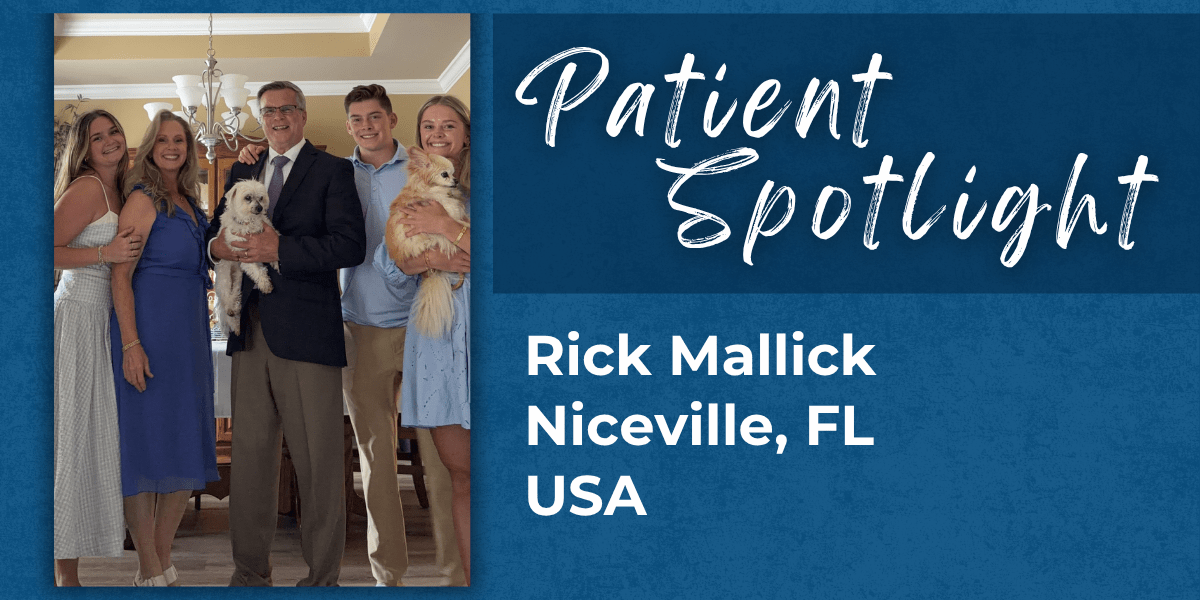
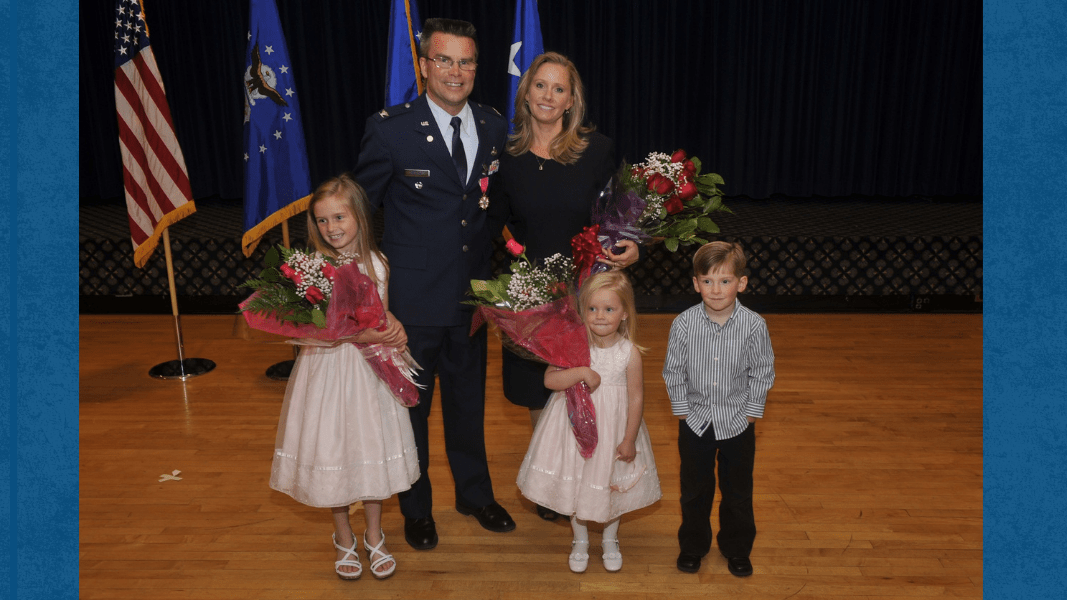
I have been married to my wonderful wife, Trish, for 25 years, and we have three children, Madison, Jackson, and Reagan now ages 19, 21, and 23. When I was first diagnosed with cancer in January 2008, they were just 1, 3, and 5 years old.
I retired from the Air Force in 2010 after 27 years of service. After retirement, I worked part-time as an information technology consultant while pursuing a master’s degree in biblical and theological studies. In 2019, I transitioned into ministry and now serve part-time on staff at my church as an assistant to the pastor.
I’ve always been passionate about physical fitness. Before my diagnosis, I ran a couple of marathons, and today I still enjoy walking and weightlifting regularly.
My cancer journey began after I developed pneumonia in December 2007. During an X-ray and CT scan, doctors discovered a golf ball-sized tumor in my right lung that affected all three lobes. In January 2008, I underwent surgery to remove my entire right lung.
At that time, there was very little known about ALK+ lung cancer. In fact, the EML4-ALK fusion in non-small cell lung cancer had only recently been discovered in 2007. Following surgery, I underwent about 16 weeks of chemotherapy with Cisplatin and Navelbine and then continued with scans every six months.
After being NED (no evidence of disease) for three and a half years, the cancer returned aggressively in December 2011 with spots in my lung, liver, and lymph nodes. My oncologist told me I likely had 9–12 months to live with chemotherapy. But just before starting treatment, my biopsy results came back showing I was ALK-positive.
My oncologist didn’t know much about ALK at the time, but she mentioned a new targeted therapy called Crizotinib. I started it immediately and saw dramatic results. I remained on Crizotinib for nearly three years before the cancer progressed.
From there, I moved to Ceritinib, although I only had limited success with it for about six months. In April 2015, I was fortunate to be accepted into the Alectinib clinical trial at Medical University of South Carolina. Once again, I experienced immediate results. Shortly afterward, Alectinib received FDA approval in December 2015.
I had an excellent six-year run on Alectinib. In 2021, cancer reappeared in my liver. The lesion remained stable for about a year while I continued treatment, and I was scheduled for cryotherapy at Mayo Clinic in Jacksonville to remove it. However, several weeks before the surgery I had a brain MRI and I had my first brain lesion. Because the cancer had spread, we canceled the procedure in January 2022 and transitioned to Lorlatinib.
Thankfully, I responded immediately to Lorlatinib and have remained on it ever since. Overall, I’ve tolerated it well, though I’ve dealt with elevated cholesterol and some cognitive and memory issues. Statins have helped manage the cholesterol, and mentally I seem to have stabilized over time.
I’m encouraged knowing there are still promising options ahead, including NVL-655 if Lorlatinib eventually stops working. I’m hoping for a long ride with Lorlatinib.
What do you know now that you wish you knew back when you were first diagnosed?
I wish I had known there were treatment options beyond traditional chemotherapy. When I was first diagnosed in 2008, chemotherapy was essentially my only option, so it was difficult to feel hopeful about long-term survival.
Everything changed once I learned I was ALK-positive and that there was a targeted therapy available. For the first time, doctors understood what was driving my cancer and had a treatment specifically designed to target it.
What would be your advice to a newly diagnosed ALK patient?
First, breathe and hold onto hope. As difficult as any cancer diagnosis is, being diagnosed with ALK-positive lung cancer means there are many effective treatment options available today, including clinical trials.
Understand that each medication may come with side effects—some easier than others—but in many cases your body adapts over time.
If possible, continue doing the things you enjoyed before your diagnosis. After surgery and chemotherapy, I was able to return to work, even if it was gradually. Stay physically active and spend time outdoors. Sunshine and movement can do wonders for both your physical and mental health. I try to walk two miles every day and lift weights several times a week.
I would also encourage people to pursue something meaningful outside of cancer—a hobby, education, ministry, travel, or a personal goal. After becoming stage IV, I pursued a master’s degree in biblical and theological studies, which eventually led to my current ministry role at church. It took me over five years to complete, but it gave me purpose and helped keep my mind focused on something beyond cancer.
There’s something powerful about continuing to plan for the future and pursuing long-term goals.
You are a very long-term survivor—over 18 years since your original diagnosis and more than 14 years as a stage IV patient. How do you stay grounded and optimistic?
From the very beginning of this journey, my wife and I adopted a simple motto: “Each day is a blessing from the Lord.” We have a plaque hanging in the kitchen that says that.
We learned to take life one day at a time and be grateful for what we had in front of us. Early on, I wasn’t thinking years ahead. I simply hoped to make it to the next milestone—another kindergarten graduation, soccer game, spelling bee, or choir concert. One event at a time, one blessing at a time.
By God’s grace, I’ve now celebrated three high school graduations and one college graduation. I’m praying I’ll be here for my other two children’s graduations from Auburn and Florida in the next 18 months as well.
My faith in a sovereign God, along with the unwavering support of my wife, children, extended family, and church family, has been foundational throughout this journey. They pray with me during difficult seasons and rejoice with me during good scan results. Cancer is not something you should try to carry alone.
Even after more than sixty scans over the years, I still experience “scanxiety.” I think that’s something most cancer patients simply learn to live with. But once I receive a stable scan or hear the words “no evidence of disease,” I try not to dwell on cancer again until the next scan approaches.
What have been your biggest challenges over the years living with ALK+ lung cancer?
One of the biggest challenges has been adapting to the different side effects that come with each treatment change.
With Crizotinib and Ceritinib, I dealt primarily with digestive issues. Alectinib was probably the most stable medication for me, although it caused elevated bilirubin levels. Lorlatinib has brought different challenges, especially increased cholesterol, cognitive slowing, and memory issues, which have been frustrating at times.
Thankfully, statins have helped control the cholesterol, and after several years on Lorlatinib, I feel the cognitive side effects have stabilized.
What makes you most hopeful about the future for ALK patients?
No one ever wants to hear the words, “You have lung cancer.” But if you are diagnosed with ALK-positive lung cancer today, there is real reason for hope.
When I was first diagnosed, my only options were surgery, chemotherapy, and radiation. Today, there are multiple generations of targeted therapies, promising clinical trials, and ongoing research focused specifically on ALK patients.
I often use a surfing analogy because my children surf on the gulf coast of Florida. I’ve been fortunate to ride four different waves of TKI treatments over the years. Every time one wave crashed, another one was there to catch.
Right now, I know drugs like NVL-655 may still be available if Lorlatinib eventually stops working. And when I hear about emerging treatments like TRI-611 and other research breakthroughs, it gives me genuine hope for the future.
I’m deeply grateful for the work being done by the entire ALK Positive community. I’ve personally benefited from years of research, advocacy, and support. I especially remember joining the Facebook group started by Merita Carroll in 2015. Her vision helped lay the foundation for an incredible community that continues to support patients and families around the world.
Interview by Christina Weber