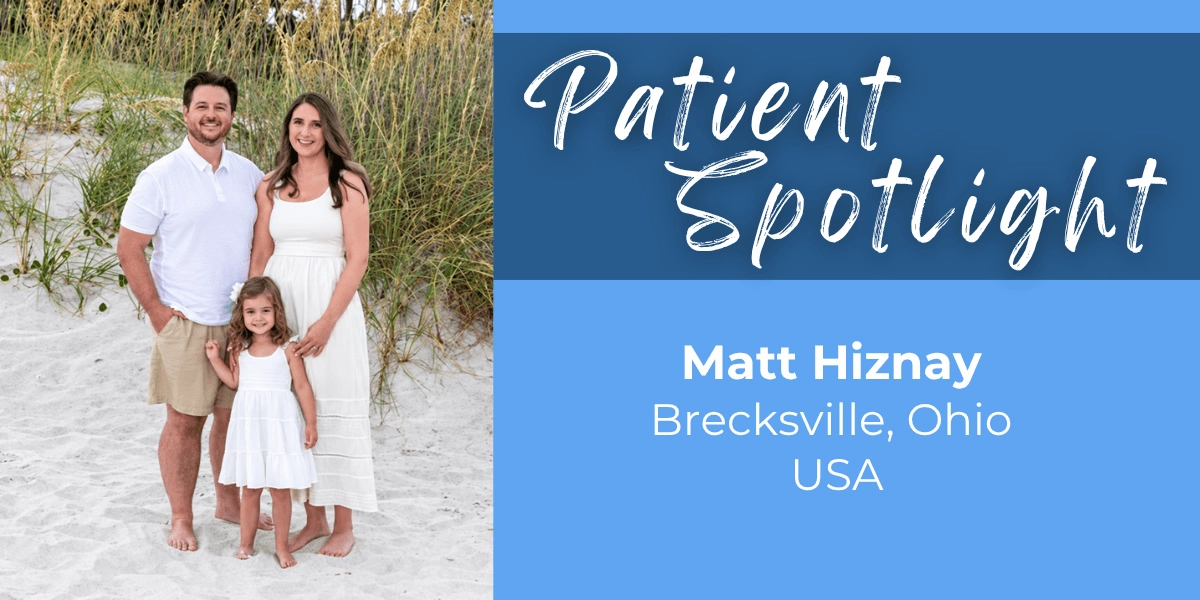
Interview with Matt Hiznay
Tell us a little about yourself – your personal and professional background, as well as your journey with ALK+ lung cancer.
I’m currently 39 years old. I live in Brecksville, Ohio, which is a suburb about halfway between Cleveland and Akron. I’m a lifelong Ohioan and grew up in Poland, a township on the Ohio–Pennsylvania line. I met my wife, Ally, in college at John Carroll University. She has been my rock throughout all this: first as my college sweetheart, then fiancée, and now spouse. We were married in 2014, as I was undergoing chemoradiotherapy. I got my PhD in 2019 from Case Western Reserve University. Professionally, I’ve been in the clinical trials / clinical decision-making space since 2019. I’m currently a scientist at Sarah Cannon Research Institute. I’m most proud of being a dad to Theodora.
Last month (August) marked the fifteenth anniversary of my diagnosis, which happened when I was 24. My only symptom in the summer of 2011 was a persistent, dry cough. I happened to go in for my annual physical, and I left with orders to go for a CT scan, which led to a biopsy and an eventual diagnosis of metastatic lung adenocarcinoma. I traveled to Cleveland Clinic to meet with Dr. Nate Pennell, who ended up being my oncologist for 14 years. He explained he would be ordering genetic testing, which could qualify me for a new type of treatment called targeted therapy. It took two weeks in 2011 for a result, and while waiting, I became very sick and ultimately stopped breathing. My life was saved by Dr. Ren Ashton of Cleveland Clinic, who inserted a catheter around my heart and drained the fluid arresting it. It was touch-and-go for a couple days there. In fact, I was still in the ICU when I learned I was ALK-positive. I started on newly approved Crizotinib two days later, which lasted about seven months. My subsequent treatments include Ceritinib, then in a phase-II trial; radiotherapy and Cisplatin; re-challenge with Crizotinib; and finally, in 2015, a phase-I trial for PF-06463922, which became Lorlatinib, and which I still take daily at lunchtime.
What do you know now that you wish you knew when you were first diagnosed? What advice would you give a newly diagnosed ALK patient?
This is actually an easy one. I assumed that, because targeted therapies and precision medicine were new, I’d be on Crizotinib for the rest of my (long) life. I truly thought I’d been fortunate to take a targeted therapy, so I’d found a magic silver bullet. I was very wrong. My advice to a newly diagnosed patient is that there isn’t necessarily a magic bullet, but rather a series of ammo. It’s not going to be neat or quick just because it’s cancer care in the 21st century. What’s important is there are lots of options—certainly more than just one drug 15 years ago—and that more options keep coming, thanks to the tireless work of scientists, doctors, and, most importantly, patients who enroll in clinical trials.
You are a long-term survivor. What have been some of your biggest challenges along the way, whether physical, mental/emotional, or anything else?
I’ve absolutely had my struggles. My immediate struggle is physical: my left arm remains partially paralyzed following chemoradiotherapy in 2014. I can’t lift it more than a 90-degree angle perpendicular to my body, in addition to the lasting paresthesia. I also have some hearing loss. Lorlatinib has its own side effects, particularly mood swings. I struggle emotionally with survivor’s guilt. In the earlier days, I made many friends in the survivor community. Unfortunately, nearly all my friends have passed away. I often wonder, why not me? I hope by living my life, but never forgetting them, I honor their memories.
What helps you maintain a feeling of hope and what allows you to keep yourself grounded day to day in order to continue to thrive?
I now work with clinical trials and clinical decision-making, which means I’m aware of up-and-coming therapies across all cancers. I am awed by the sheer number of trials testing increasingly complex, yet elegant, treatments. As I said earlier, it’s not about a magic bullet, but rather a series of options. As for keeping myself grounded, I have a three-year-old daughter—she’s great for making me too overwhelmed to worry about anything else.
A lot of progress has been made in ALK research since the time you were diagnosed. What are you most excited about, or what are your hopes when it comes to the future of ALK-positive lung cancer (and ALK-positive cancer in general)?
Science builds on the foundations of scientists and clinical trial–participating patients, as it has done for generations. Much of what gets built on comes from unexpected places. I’m excited about cancer vaccines, which come from the groundbreaking mRNA vaccines developed during the pandemic. I envision a day when a personalized cancer vaccine is used to help the body’s natural immune system destroy a tumor. One thing I’ve learned in fifteen years, though, is to expect the unexpected.
Interview by Christina Weber