Status: Recruiting
Phase: Phase 1/2 Study of TRI-611 in ALK-positive NSCLC
Treatment Type: Targeted Therapy (oral medication)
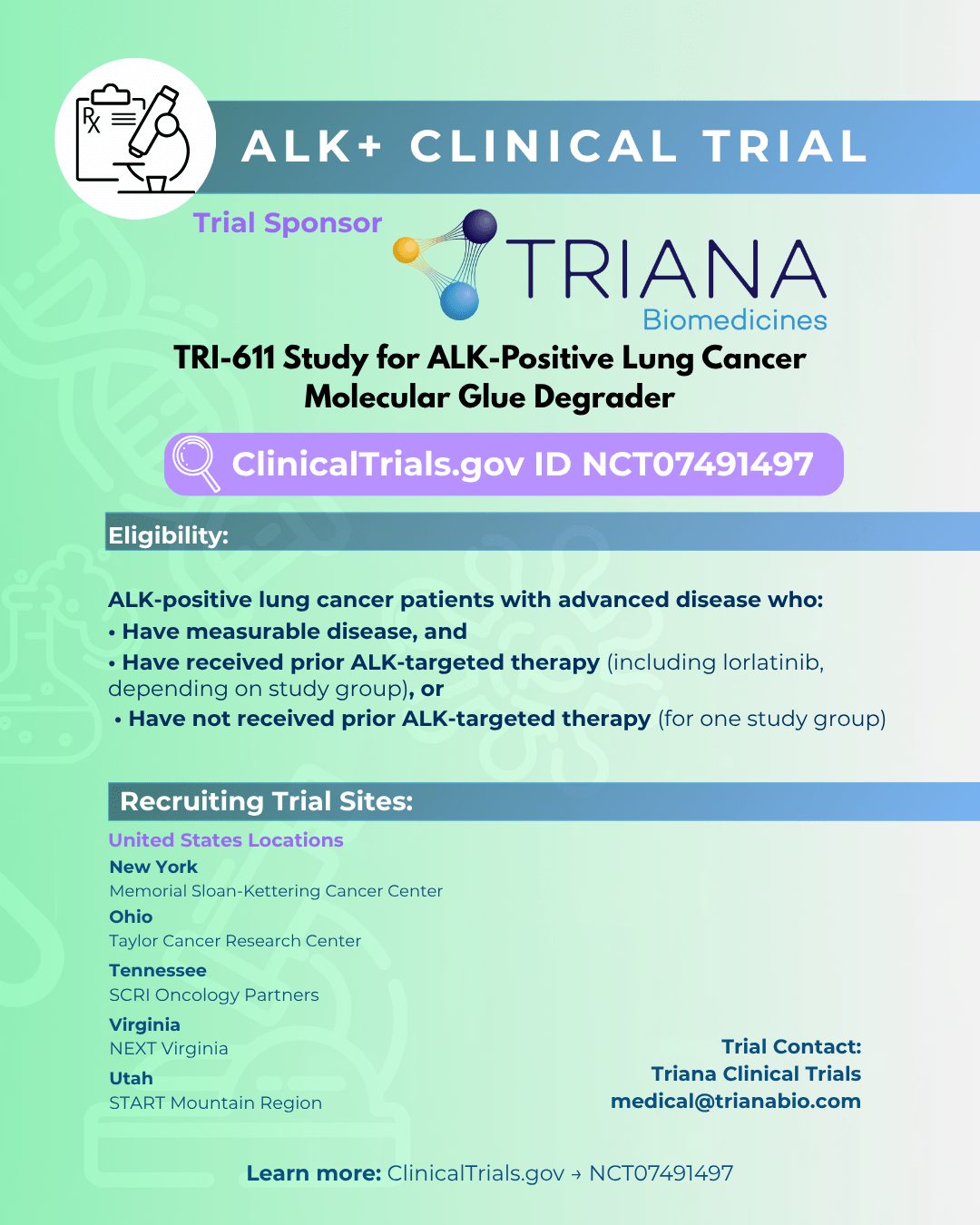
Drug: TRI-611
Study Contact: Triana Clinical Trials, medical@trianabio.com
Introduction
Triana’s Phase 1/2 first-in-human open label trial will determine the safety, recommended dose, and antitumor activity of TRI-611 in adults with ALK-positive non-small cell lung cancer (NSCLC). TRI-611 is a newly developed investigational drug called a molecular glue degrader. In preclinical models, TRI-611 is a potent, highly selective, brain-penetrant, oral ALK fusion protein degrader that operates independently of the ALK binding site targeted by current tyrosine kinase inhibitors (TKIs). Because TRI-611 degrades the ALK fusion protein rather than simply inhibiting it, it may overcome or delay the resistance that commonly develops with current ALK TKIs. This may lead to deeper and more durable responses in patients with ALK-positive NSCLC.
There are 5 sites in the USA that are enrolling patients, with additional sites planned, both in the US and ex-US. TRI-611 was granted Fast Track designation by the FDA in March 2026 intended to accelerate development and acknowledge urgent unmet medical needs.
How the drug works
Rather than binding to the ALK protein and blocking its cell-growth promoting activity as TKIs do, TRI-611 binds to an E3 ligase, part of the cancer cell’s natural protein cleanup system, that tags proteins for removal by the proteasome. The TRI-611:E3 ligase complex then binds to the ALK protein that drives the cancer, promoting degradation of ALK. In other words, TRI-611 acts as a molecular matchmaker that forces the ALK proteins into the cell’s proteasome system, a protein recycling complex inside the cell, to destroy them. The proteasome engulfs the ALK protein, unfolds it, and breaks it down into small peptides, eliminating the ALK protein driver from the cell. Based on preclinical data, this should occur even if prior ALK mutations have reduced TKI binding, because TRI-611 binds to a different part of the protein, and the protein is destroyed rather than inhibited.
Trial Description
Experimental Part 1: Subjects will take TRI-611 tablets once daily at the same time each day. This is a typical dose-escalation design with each dose level enrolling 3 to 6 patients, and backfills at determined dose levels. The dose increases step-by-step in new patient groups until the maximum tolerated dose (MTD) and/or the recommended Phase 2 dose (RP2D) is determined based on dose-limiting toxicities (DLTs) observed during treatment. Each subject will be observed for DLTs during the first treatment cycle (28 days) before enrollment begins at the next dose level. Certain dose level groups may later be expanded (called backfilling) to further study safety, drug levels in the body (pharmacokinetics, PK), drug activity (pharmacodynamics, PD), and efficacy.
Experimental Part 2: Following identification of the optimal dose distinguished in Part 1, further monotherapy expansion cohorts will be initiated. Cohorts enrolled in Part 2 will include subjects who fit the following criteria:
Cohort M1; prior lorlatinib, neladalkib naïve cohort
Cohort M2: prior lorlatinib, and prior neladalkib cohort
Cohort M3: first line monotherapy cohort
Approximately 160 eligible subjects will be enrolled in the study.
Key Inclusion Criteria
A subject must have locally advanced unresectable, or metastatic NSCLC harboring an ALK fusion. Subject must have measurable disease per RECIST v1.1. For part 1 prior treatment with 2 to 3 ALK TKIs, prior treatment with lorlatinib is required but must not have been in the first line.
In part 2, cohort M1 requires prior treatment with 2 to 3 ALK TKIs, prior treatment with lorlatinib is required but must not have been in the first line, prior treatment with neladalkib is excluded. Cohort M2 requires prior treatment with more than 3 ALK TKIs, prior treatment with lorlatinib and neladalkib is required but neither may have been in the first line. For cohort M3, a subject must be altogether TKI naïve. Up to 2 prior lines of chemotherapy and/or immunotherapy are allowed for all subjects in Experimental Parts 1 & 2 except for those enrolled in cohort M3, for which they must be chemotherapy naïve. It is preferable that pretreatment tumor samples be obtained from a progressing lesion during or after disease progression on subject’s last ALK-targeted TKI. (This list of inclusion criteria is not all-inclusive).
Key Exclusion Criteria
Patient’s tumor cannot harbor any additional driver alterations, based on a post-progression tumor sample and/or ctDNA. For participants with central nervous system (CNS) metastases or spinal cord compression, they must not be associated with progressive neurological symptoms or require increasing doses of corticosteroids to control the CNS disease. (This list of exclusion criteria is not all-inclusive).
About TRIANA Biomedicines, Inc.
TRIANA Biomedicines is a privately held biotechnology company based in Lexington, Massachusetts, with a team of scientists, physicians, and drug-development specialists. The company was intentionally created by leading investors, including RA Capital Management and Atlas Venture, to develop a new type of medicine; i.e. molecular-glue degraders. This approach is inspired by discoveries behind several successful cancer drugs from Celgene that work by marking harmful proteins for destruction in the cell. Experienced biotechnology executive Dr. Patrick Trojer leads the company. TRIANA launched in 2022 with about $110 million in funding from investors including RA capital, Atlas Venture, Lightspeed Venture Partners, Pfizer Ventures, Surveyor Capital, and Logos Capital. In 2025 the company raised an additional $120 million led by Ascenta Capital and Bessemer Venture Partners, with participation from Regeneron Ventures, Invus, YK Bioventures, Finchley Healthcare Ventures, and all major series A investors and bringing total venture investment to over $200 million. In addition to this funding, TRIANA has formed two research collaborations with major pharmaceutical companies: a partnership with Pfizer to discover new molecular-glue medicines, which includes an upfront payment of $49 million and could provide TRIANA with more than $1.5 billion in potential milestone payments and royalties if resulting drugs advance, and a January 2026 collaboration with the Janssen division of Johnson & Johnson to use TRIANA’s platform to find therapies for difficult-to-treat cancer targets. Together, these investors and partnerships support the company’s efforts to develop new cancer treatments such as TRI611.
Initial Trial Locations
United States
New York Locations
New York, New York, United States, 10065
Recruiting
Memorial Sloan-Kettering Cancer Center
Principal Investigator:
Alexander Drilon, MD
Ohio Locations
Maumee, Ohio, United States, 43537
Recruiting
Taylor Cancer Research Center
Principal Investigator:
John Nemunaitis, MD
Tennessee Locations
Nashville, Tennessee, United States, 37203
Recruiting
SCRI Oncology Partners
Principal Investigator:
Melissa Johnson, MD
Utah Locations
West Valley City, Utah, United States, 84119
Recruiting
START Mountain Region
Principal Investigator:
José Pacheco, MD
Virginia Locations
Fairfax, Virginia, United States, 22031
Recruiting
NEXT Virginia
Principal Investigator:
Alexander Spira, MD
View Full Trial Details on ClinicalTrials.gov
Clinical trial details may change. Please refer to ClinicalTrials.gov for the most up-to-date information.
Jeffrey M. Sturm BS, MA, MBA
ALK Positive, Inc. www.alkpositive.org
Member, Medical Committees
Member Board of Directors
Eleven-year ALK NSCLC survivor